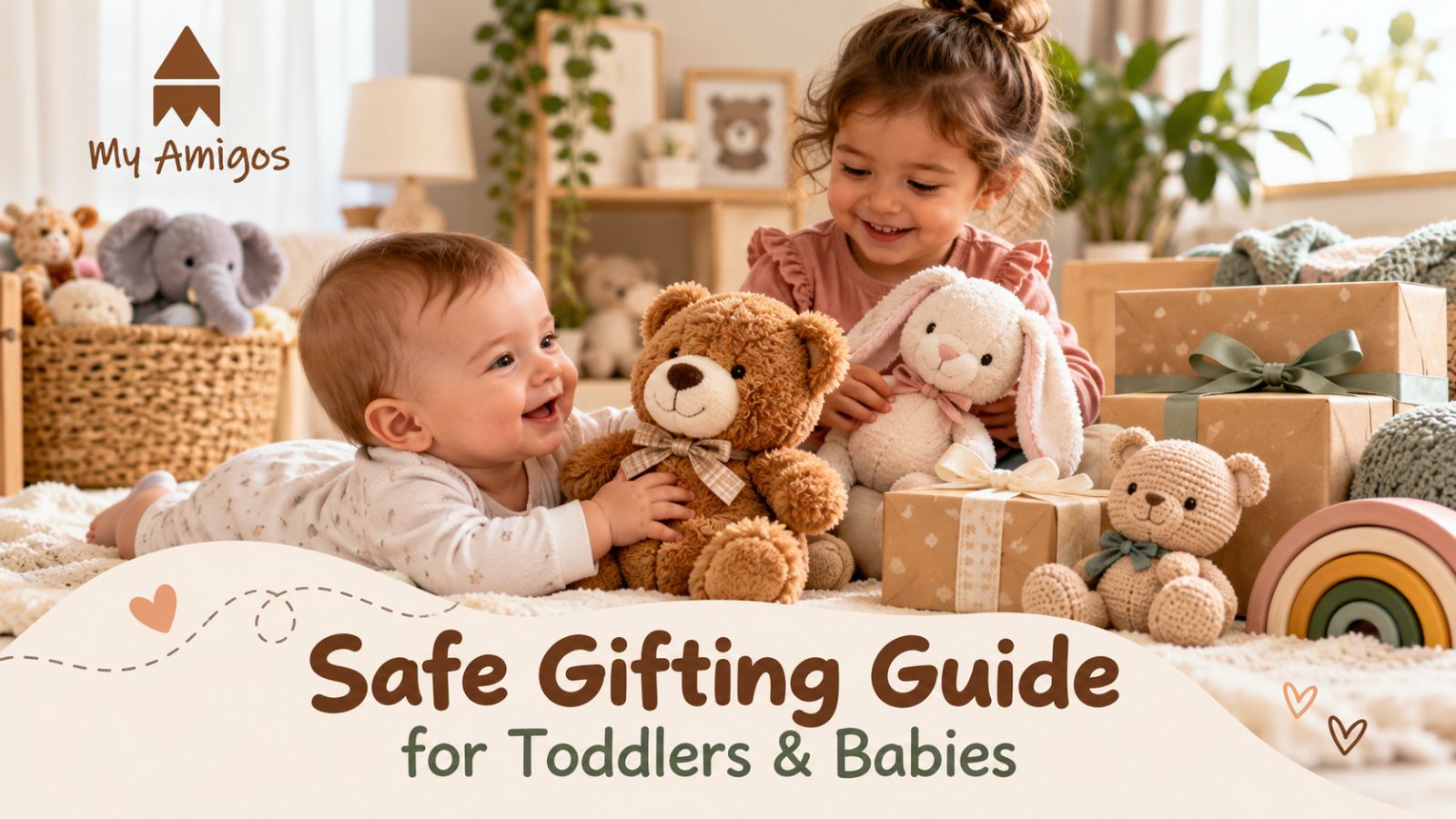
Choosing a soft toy for a baby or toddler can feel simple until you start considering how young children actually interact with toys. Babies explore with their mouths, toddlers pull and tug at seams, and older siblings may accidentally leave unsuitable toys within reach. Learning how to gift soft toys safely therefore means looking beyond appearance and focusing on age suitability, construction, materials, detachable features and care instructions. A thoughtful gift should be enjoyable, but it should also suit the child’s developmental stage and the environment in which it will be used.
Soft toys often look harmless because they are soft, lightweight and designed for cuddling. However, softness alone does not make a toy suitable for every child. Young children can pull at ears, tails, ribbons, eyes, stitching and other decorative elements. If a component becomes loose, it may create a choking or ingestion hazard.
Official toy-safety guidance recommends checking age information and choosing products appropriate for the child’s age and abilities. The Australian Competition and Consumer Commission (ACCC), for example, advises parents to choose sturdy, well-made toys and to check that soft toys are securely sewn, with no loose threads that could create choking or strangulation risks.
The safest approach is therefore to assess the complete toy rather than focusing on one feature. A plush animal may be beautifully designed, but if it has detachable decorations or unsuitable accessories, it may not be appropriate for a baby. A simpler design can sometimes be the more practical choice.
When buying soft toys for a young child, start with the manufacturer’s recommended age. Age guidance is not simply a marketing suggestion; it provides important information about the intended developmental stage and potential hazards.
Look carefully at the construction. Check whether the seams appear secure, whether facial features are firmly attached and whether there are loose threads, ribbons or decorative pieces. A toy intended for a child who mouths objects should be particularly simple and robust.
A useful pre-gifting inspection includes:
The US Consumer Product Safety Commission (CPSC) similarly advises caregivers to follow age guidance and choose toys that match a child’s age, interests and abilities.
A label is useful, but it should not replace common sense. Children of the same age can have different abilities and behaviours. Some babies and toddlers are particularly persistent about chewing, pulling or dismantling objects.
For example, imagine buying a plush rabbit for a 14-month-old. The rabbit may be labelled for young children, but it is still sensible to inspect the whiskers, eyes, nose, stitching and any attached accessories before giving it to the child. If anything looks loose or poorly secured, choose another product.
This additional check is especially valuable with gifts because the purchaser may not know the child’s habits as well as the parent or primary carer does.
A baby safe gifting guide should recognise that developmental stages influence how children interact with toys. A newborn does not play with a plush toy in the same way as a two-year-old. Babies may primarily look at, touch and eventually mouth objects, while toddlers are more likely to pull, carry, throw, chew and investigate them.
For very young babies, choose designs that are lightweight, simple and free from small detachable features. For toddlers, consider whether the toy can withstand more active handling without pieces becoming detached.
The CPSC’s age-determination guidance notes that stuffed toys for very young children should be simple, soft and sturdy, with facial features designed to remain securely attached rather than relying on loose decorative elements.
For babies who are beginning to grasp objects, avoid toys with features that can be pulled off or placed easily into the mouth. Long loose threads, cords, ribbons and poorly secured decorations deserve particular attention.
The ACCC specifically advises that soft toys should be securely sewn and free from long, loose pieces of thread. It also recommends keeping soft toys out of a baby’s sleep environment.
This distinction is important: a soft toy may be suitable for supervised play but not appropriate to leave inside a cot or other sleep space.
Toddlers can be surprisingly strong when they are determined to investigate something. They may pull an animal’s ears, chew its nose, drag it across the floor or attempt to open a stitched section.
At this stage, durability matters. A well-constructed toy with securely sewn components is generally more suitable than one with numerous decorative additions. Parents should still inspect the toy periodically because even a well-made product can become damaged through repeated use.
The term non toxic plush toys is commonly used when parents are looking for products made with materials they perceive as safer for children. However, shoppers should avoid treating a simple marketing phrase as a complete safety assessment.
Look for clear information about the materials, manufacturer, care instructions and applicable safety standards. If a product makes specific material claims, check whether the manufacturer provides meaningful information supporting those claims.
It is also important to remember that chemical composition is only one part of toy safety. A plush toy could use materials that meet applicable requirements while still having a physical hazard, such as a loose eye, weak seam or long cord.
Consider two plush toys made from similar fabrics. One has embroidered facial features and strong stitching. The other has plastic eyes, decorative ribbons and several small accessories attached to the body. The first may present fewer detachable-component concerns for a young child, regardless of the similarity between the fabrics.
For this reason, parents should assess both what the toy is made from and how it is constructed.
If a child is likely to chew or mouth the toy, a straightforward design can be easier to inspect and maintain. The ACCC recommends checking that toys are sturdy and well made, particularly because babies and young children may bite, tug, suck, throw or otherwise handle them vigorously.
Infant safe toys should generally have construction appropriate for a child who is still developing coordination and frequently explores objects with their mouth. Small components can become particularly concerning at this stage.
Pay attention to:
The ACCC advises that babies and toddlers should not be given toys containing small parts or small objects such as magnets, coins, batteries and screws.
This does not mean every plush toy with a decorative element is automatically unsuitable for every child. The appropriate choice depends on the manufacturer’s age guidance, construction, applicable standards and the child’s developmental stage.
Stuffed toys can remain in a child’s collection for years, which means their condition can change considerably after purchase. Seams can weaken, stitching can loosen and decorative features can become damaged.
A toy that was perfectly secure when purchased may eventually require removal from use. Parents and carers should therefore inspect frequently handled toys, particularly those that are washed regularly or subjected to rough play.
The ACCC recommends checking toys for signs of breaking, brittleness, tearing or falling apart and disposing of damaged toys rather than continuing to use them.
Before giving a plush toy to a child, gently inspect the major seams and attachments. Look for loose threads, gaps, exposed filling and parts that move when they should remain firmly attached.
Do not aggressively pull components to the point of damaging the toy, but do pay attention to anything that already appears unstable. If a decorative feature feels loose before the toy has even been used, it is reasonable to choose a different gift.
The same check should be repeated after washing. Cleaning can place stress on stitching and seams, particularly when a toy requires frequent laundering.
Eco friendly gifts can be thoughtful choices because many families are increasingly interested in reducing unnecessary packaging and choosing durable products. However, environmental considerations should not replace child-safety checks.
A reusable cotton toy, for example, may appeal to a parent who prefers natural-looking materials. The buyer should still check its age suitability, construction and care requirements. Natural or recycled materials are not automatically suitable for babies simply because they are described as environmentally friendly.
A good approach is to consider sustainability and safety together. A durable toy that can be cleaned appropriately and used for a long time may offer practical value, provided it is also designed for the child’s age and developmental stage.
Handmade gifts can have a personal quality that makes them especially meaningful. A handmade plush animal, doll or cotton toy can become a memorable keepsake, but handmade does not automatically mean child-safe.
Before gifting a handmade item to a baby or toddler, ask how it was constructed and what materials were used. Check whether the maker specifies an intended age range and whether the product has been designed for supervised play or decorative use.
Particular care is needed with loose embroidery, buttons, beads, ribbons, yarn and other decorative features. If the maker cannot provide clear information about suitability, it may be better to treat the item as a decorative keepsake rather than a child’s plaything.
Cotton toys are often attractive to parents looking for soft, simple textures. Cotton itself, however, is only one part of the overall product. The fabric, dyes, thread, filling, stitching and decorative components all contribute to the finished toy.
When choosing a cotton plush toy, look for clear care instructions and information about the materials. Consider whether the toy can be cleaned properly and whether repeated washing could affect its structural integrity.
For babies and toddlers, simplicity can be valuable. A soft cotton toy with securely stitched features may be easier to inspect than an elaborate plush design containing numerous detachable accessories.
Some plush toys include lights, sounds or movement. These features can make a toy more entertaining, but they can also introduce additional safety considerations.
Button or coin batteries are particularly hazardous if swallowed. The ACCC warns that these batteries can cause serious injury and recommends checking toys with electronic features for secure battery compartments.
If a plush toy uses a button battery, check that the compartment is secured as required and inspect the toy for damage. If the battery compartment becomes loose or damaged, stop using the product and keep it away from children.
The CPSC likewise highlights the serious dangers associated with button-cell and coin batteries and recommends secure battery compartments for toys containing them.
For very young children, a non-electronic plush toy may be a simpler choice when the extra features are not necessary.
One common mistake is choosing a toy based entirely on appearance. A beautifully designed plush animal may not be appropriate for the recipient’s age.
Another mistake is assuming that a toy is safe because it is soft. Softness does not address choking hazards, loose stitching, cords, magnets or battery compartments.
Parents and gift-givers should also avoid removing packaging and labels before checking the instructions. Safety information and age guidance can provide useful details that are easily overlooked.
Finally, avoid leaving packaging with the child. The CPSC recommends disposing of plastic wrapping and other toy packaging immediately after opening because packaging itself can create hazards.
Before giving a plush toy to a baby or toddler, work through this simple checklist:
A birthday, baby shower or first Christmas can encourage people to choose elaborate gifts. Yet the most appropriate toy is not necessarily the one with the most features.
Think about how the recipient will actually use the gift. A six-month-old may appreciate a lightweight, easy-to-grasp plush toy with simple embroidered details. A two-year-old may enjoy a larger animal that can withstand carrying and imaginative play. An older child may be ready for more detailed designs, provided the product is age appropriate.
It is also worth considering the household. If the recipient has younger siblings, a toy with small accessories may create an additional concern because it could be passed down or left within the reach of a younger child. The CPSC advises considering the ages of children in the household when selecting toys because older children’s toys can contain features that pose hazards to younger siblings.
Learning how to gift soft toys safely does not mean choosing boring gifts. It simply means putting a little more thought into construction, age suitability, materials and intended use. A beautifully made plush toy can still be soft, colourful, comforting and fun while incorporating practical safety considerations.
For toddlers & babies, the strongest choices are usually those that match their developmental stage and can withstand the way young children naturally explore their surroundings. A simple, sturdy toy with securely attached features can offer plenty of imaginative and sensory value without unnecessary additions.
My Amigos can be considered by families looking for thoughtfully selected plush and gifting options, with the child’s age and intended use kept at the centre of the purchasing decision. The important step is always to check the individual product’s safety information rather than assuming every soft toy has the same suitability.
When choosing a gift from My Amigos, parents and gift-givers can use this guide as a practical reminder to consider age guidance, construction, materials, detachable parts, cleaning and the child’s individual stage. A thoughtful gift is one that brings enjoyment while also respecting the everyday safety needs of young children.
Start with the manufacturer’s recommended age and safety information. Then inspect the toy’s seams, stitching, eyes, nose and other decorative components. Look for anything loose, detachable or poorly secured. Babies often mouth objects, so a simple design with securely sewn features is generally preferable to an elaborate plush toy with multiple small accessories. Also consider whether the toy is intended for supervised play rather than use in a sleep environment.
Handmade plush toys can be suitable, but they should not be assumed to be safe simply because they are handmade. Check the materials, stitching, age recommendation and construction. Pay particular attention to buttons, beads, ribbons, embroidery, loose threads and other decorative elements. If the maker cannot provide clear information about intended use or age suitability, it is safer to treat the item as decorative rather than giving it to a baby or young toddler for unsupervised play.
No. Material safety is only one aspect of overall toy safety. A product can use appropriate materials but still have physical hazards such as loose eyes, weak seams, long cords or detachable pieces. When selecting non toxic plush toys, consider the material information alongside age guidance, construction, maintenance instructions and the child’s developmental abilities. Looking at the complete product gives a more useful safety assessment than relying on a single material claim.
Parents should not assume that a soft toy suitable for play is also suitable for a baby’s sleep environment. The ACCC specifically advises keeping toys, including soft toys, out of a baby’s sleep environment. Follow the safe-sleep guidance provided by your local health authority or healthcare professional for the child’s age and circumstances. If a plush toy is given as a gift, make clear to caregivers that it should be used according to appropriate play and sleep-safety guidance.
There is no universal inspection interval because use varies considerably. However, parents should routinely look at frequently used toys and inspect them whenever they have been washed, heavily played with or visibly damaged. Check seams, stitching, facial features, filling and decorative parts. If a toy is tearing, coming apart or releasing components, stop allowing the child to use it. Regular inspection is particularly important for babies and toddlers who pull, chew and mouth toys.