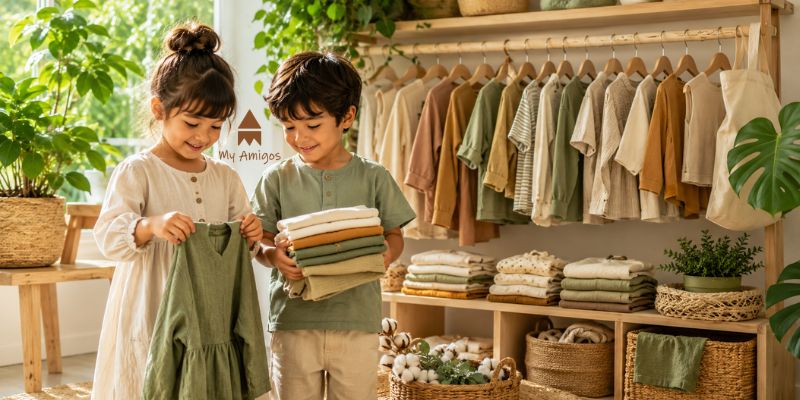
In today’s world, where the environmental consciousness among parents has grown, sustainable wardrobe planning is becoming increasingly important in parenting. Clothing is replaced frequently due to the fast growth of children. Hence, the kids’ fashion industry is among those that face higher clothing turnover. Sustainable wardrobe planning for kids is beneficial since it reduces the amount of textile waste and helps save money in the future.
For families who are interested in eco-friendly clothes in India, sustainable wardrobe planning is no longer an option, but a way of living. Through wearing organic kids’ clothes and choosing sustainable fabrics such as breathable fabrics, parents are able to create a sustainable wardrobe for their children. Know how to build a sustainable kids wardrobe in detail.
According to the UN Environment Program, the textile industry accounts for about 10% of greenhouse gas emissions around the world. Moreover, it is reported by the Ellen MacArthur Foundation that each second, a truckload of textile goods is disposed of in a landfill or burned.
The fashion industry has been blamed for 10% of global carbon emissions, according to UNEP reports. Moreover, the Ellen MacArthur Foundation has reported that a truckload of fabric is burned every second globally.
Children’s clothes have made a significant contribution to this problem due to their fast growth rate. This results in many usable clothes being disposed of.
Some ways of solving these problems are sustainable wardrobe management which will involve:
It should be noted that when raising children, the idea should not be buying new clothes but better clothes.
In recent years, there has been an increase in sustainable fashion in India. According to a report by Statista, Indian consumers show increasing concern about environmentally responsible products, especially young families and those living in cities.
There has been an increase in demand for eco-friendly clothes from brands since consumers are more concerned about:
Fast fashion encourages frequent purchases of inexpensive garments that often have short lifespans. In contrast, slow fashion kids focus on quality, durability, and responsible production.
| Feature | Slow Fashion | Fast Fashion |
| Material Quality | High-quality fabrics | Lower-cost materials |
| Durability | Long-lasting | Short lifespan |
| Production | Ethical and transparent | Mass production |
| Environmental Impact | Lower | Higher |
| Cost Per Wear | Lower over time | Higher over time |
Children’s skin is more sensitive than adult skin. According to dermatology research, young children are more susceptible to irritation caused by harsh chemicals and synthetic materials.
Organic cotton kids clothes are produced without synthetic pesticides, toxic fertilizers, or genetically modified seeds.
| Benefit | Explanation |
| Softness | Gentle on sensitive skin |
| Breathability | Improves comfort in warm weather |
| Reduced Chemical Exposure | Fewer harmful residues |
| Durability | Often lasts longer after repeated washing |
| Sustainability | Lower environmental impact |
Parents living in warmer climates particularly appreciate breathable fabrics because they help regulate body temperature and reduce discomfort.
Comfort is one of the most important factors when selecting children’s clothing. Breathable fabrics allow air circulation and moisture evaporation, helping children stay comfortable during:
Common breathable fabrics include:
Many eco friendly kids wear India brands now prioritize these materials due to their comfort and sustainability benefits.
One of the most successful approaches to planning a sustainable wardrobe is through implementing a capsule wardrobe for children.
A capsule wardrobe is a small selection of versatile clothing options with easy mix-and-match capabilities.
| Item | Quantity |
| T-Shirts | 6-8 |
| Shorts | 3-4 |
| Pants | 3-4 |
| Dresses (if applicable) | 3-5 |
| Sweaters | 2-3 |
| Jackets | 1-2 |
| Sleepwear Sets | 3-4 |
| Shoes | 2-3 pairs |
This means instead of having many articles of rarely used clothing, children will have fewer clothes that they will actually use. The benefit of this type of system is it will make getting dressed every day much easier while also creating less clutter and increasing savings.
An example of a family spending very little each month on low cost clothing:
While the upfront costs for the more sustainable options may appear to be higher, in many cases, the annual spending will actually be lower due to the lack of need for as many replacements.
Ethical Parenting means that you make decisions with the intent to do good for both your child and society at large.
The choices that you make regarding clothing provide you with an opportunity to impart knowledge on your child regarding:
Once children learn why their parents choose to plan their wardrobes in a sustainable manner, they too will generally have a more thoughtful approach to where and how they spend their money on clothing.
There are many tips for you to make a sustainable wardrobe for kids.
Quality clothing that can stand up to active play and repeated washing will last longer.
Neutral colors make mixing and matching easier, creating more different outfits.
Having items that can be layered will enable you to wear your clothes throughout the year.
Buying secondhand clothing allows you to give garments a longer lifespan.
Rather than discarding clothing that is still usable, donate it to a family or charity that would use it.
Timeless styles will last longer than trendy clothing.
Sustainable planning of a wardrobe goes beyond the immediate benefit of just your family.
The World Bank reports that the fashion industry uses about 93 billion cubic meters of water each year. Buying fewer clothes saves many valuable resources, including the water used in the production of clothes.
Every sustainable purchase positively impacts:
Designing a sustainable wardrobe for children does not imply striving to achieve absolute perfection. It implies making choices, taking into account a balanced combination of comfort, durability, cost, and ecological sustainability of clothes. So,you have learned how to build a sustainable kids wardrobe.
Thanks to a sustainable wardrobe approach, purchasing organic cotton kids’ clothes, choosing breathable fabrics, purchasing slow fashion kids clothes, and creating a capsule wardrobe kids concept, you can avoid unnecessary waste production, providing your kids with durable, comfortable clothes.
More and more parents begin to understand that sustainability in clothing is about much more than being environmentally friendly. It is a very smart and economical choice when it comes to parenting. My Amigos can help you out with the most useful sustainable wardrobe solutions.
The sustainable wardrobe planning is based on creating a wardrobe of garments that are durable, multi-functional, ethically produced, and environmentally friendly.
Organic cotton kids’ clothes are softer and breathable, contain less residue from chemicals used in the production process, and have less environmental impact than cotton ones.
A capsule wardrobe for kids is a wardrobe concept based on using a small set of multi-functional clothes that are combinable to form many different combinations.
Some of the sustainable fashion brands may require higher initial investments; however, the long-lasting nature of such garments makes them less costly.
Among the most breathable fabrics for children’s clothing are organic cotton, bamboo, muslin cotton, and linen blends.